
Waterjet Knowledge
Why Are Different Orifice Sizes Used When Waterjet Cutting Gemstones?
Why Are Different Orifice Sizes Used When Waterjet Cutting Gemstones?
When using an abrasive waterjet to cut gemstones, stone, or other valuable, brittle materials, the diameter of the Nozzle Orifice directly influences water flow rate, jet power, kerf width, abrasive consumption, and cutting precision.
In practical applications, a smaller orifice is not necessarily better, nor does a larger orifice automatically guarantee greater power. Making the right choice depends on factors such as the type and thickness of the material, specific cutting requirements, pump performance, and the configuration of the Focusing Tube.
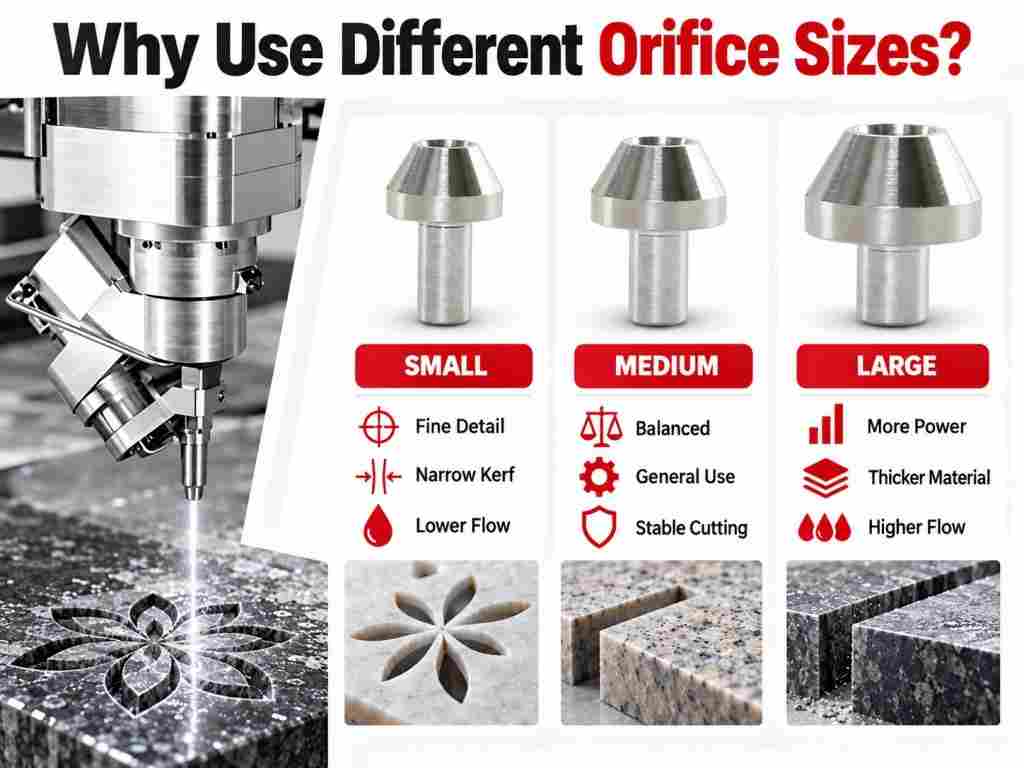
What Does the Waterjet Orifice Do?
The nozzle orifice converts high-pressure water into an extremely fine, high-velocity stream.
During the abrasive Waterjet Cutting Process, this stream enters a mixing chamber, draws in garnet abrasive, and subsequently passes through a focusing tube.
Consequently, the nozzle orifice influences several factors: water flow rate, jet energy, cutting speed, kerf width, and cutting precision.
Even a minute change in the diameter of the nozzle orifice can significantly alter cutting conditions.
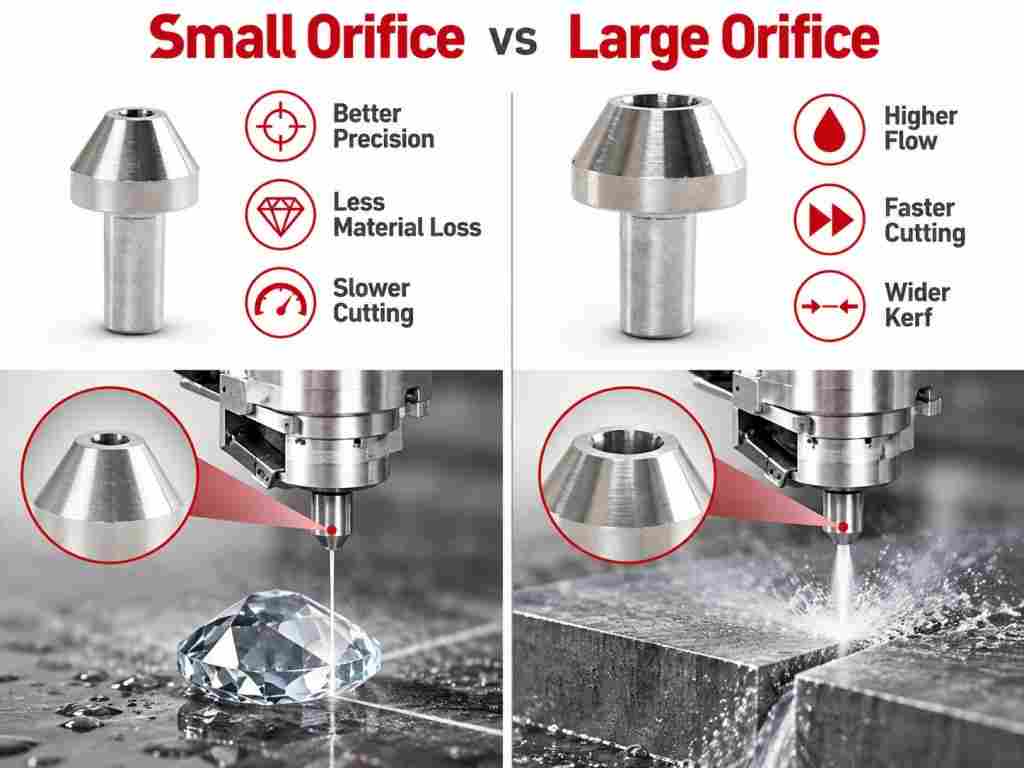
1. Smaller Orifices for Fine and Precise Cutting
A smaller nozzle orifice typically results in a lower water flow rate; when paired with a narrower focusing tube, it produces a finer cutting jet.
This yields several benefits: a narrower kerf, precise contours, improved material utilization, and reduced water consumption.
This approach is particularly advantageous when processing high-value workpieces, where minimizing material loss—caused by the width of the cut—is essential.
However, a finer jet also possesses a more limited cutting capacity, which may lead to slower cutting speeds when processing thick or hard materials.
2. Larger Orifices for More Cutting Power
For thicker or harder-to-cut materials, a larger nozzle orifice allows for a greater flow rate of water.
By using an appropriate combination of pump and nozzle, more energy can be delivered to the cutting zone.
Employing a larger nozzle orifice can be advantageous when cutting thicker materials, increasing cutting speeds, utilizing a higher flow rate of abrasive, or enhancing penetration capability.
The trade-off is that such a configuration typically consumes more water and abrasive, and may result in a wider kerf (cut width).
3. Material Value Changes the Selection
Cutting gemstones differs from cutting standard structural steel.
With expensive materials, even a slight increase in material loss along each cutting path can significantly impact the final yield.
Consequently, when processing high-value materials, operators often prefer using a finer, more precise jet—even if it means a slower cutting speed.
In other scenarios, however, where production speed is more critical than the width of the kerf (the cut gap), a larger-scale configuration may be more appropriate.
Ultimately, selecting the optimal nozzle orifice size requires striking a balance between several key factors:
precision, material yield, and cutting speed.
4. Orifice Size Must Match the Focusing Tube
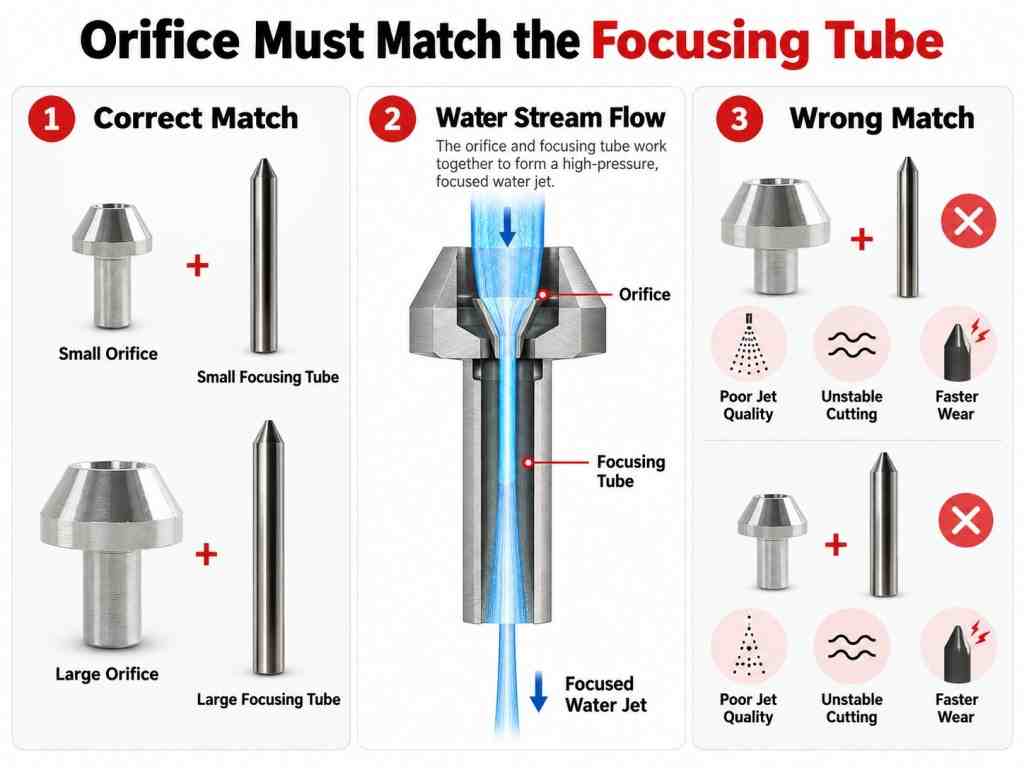
An orifice (nozzle jewel) should not be selected in isolation.
It must be considered in conjunction with several other elements: the mixing chamber, the focusing tube (Mixing Tube), the abrasive flow rate, the pump pressure, and the available power.
If the focusing tube is too large relative to the water jet stream, the jet’s concentration may decrease, which in turn impairs the acceleration of the abrasive particles.
If the components are undersized or poorly matched, it can negatively affect abrasive delivery and the stability of the cutting process.
The orifice and the focusing tube should be viewed as a matched nozzle set.
5. Pump Capacity Also Limits Orifice Size
A larger orifice requires a higher water flow rate.
Consequently, the pump must have sufficient power and flow capacity to maintain the required operating pressure.
Installing an excessively large orifice does not automatically improve cutting performance.
If the pump cannot maintain the necessary pressure with a given orifice, it may lead to issues such as reduced cutting pressure, slower cutting speeds, an unstable cutting process, and increased operating costs.
Always select an orifice based on the actual capabilities of your pump.
What Happens If the Orifice Is Too Small or Too Large?
An orifice that is too small may result in: reduced cutting capacity, slower cutting speeds, difficulty in cutting thicker materials, and a decrease in the amount of abrasive delivered.
While this might be acceptable for precision machining, it can lead to lower overall production efficiency.
Conversely, if the orifice diameter is too large for a given application, it may lead to: a wider kerf (cut width), increased water and abrasive consumption, greater material loss, and an excessive load on the pump.
For the processing of expensive gemstones, an unnecessarily wide kerf is particularly undesirable.
Orifice Condition Is Just as Important as Size
Even if the orifice size is selected correctly, an ideal cutting result cannot be achieved if the nozzle (jewel orifice) itself is worn or damaged.
Damage to a ruby, sapphire, or diamond orifice can lead to an irregular waterjet stream.
If a focusing tube exhibits uneven, one-sided wear, the condition of the orifice and its alignment should be inspected.
How to Choose the Right Orifice Size
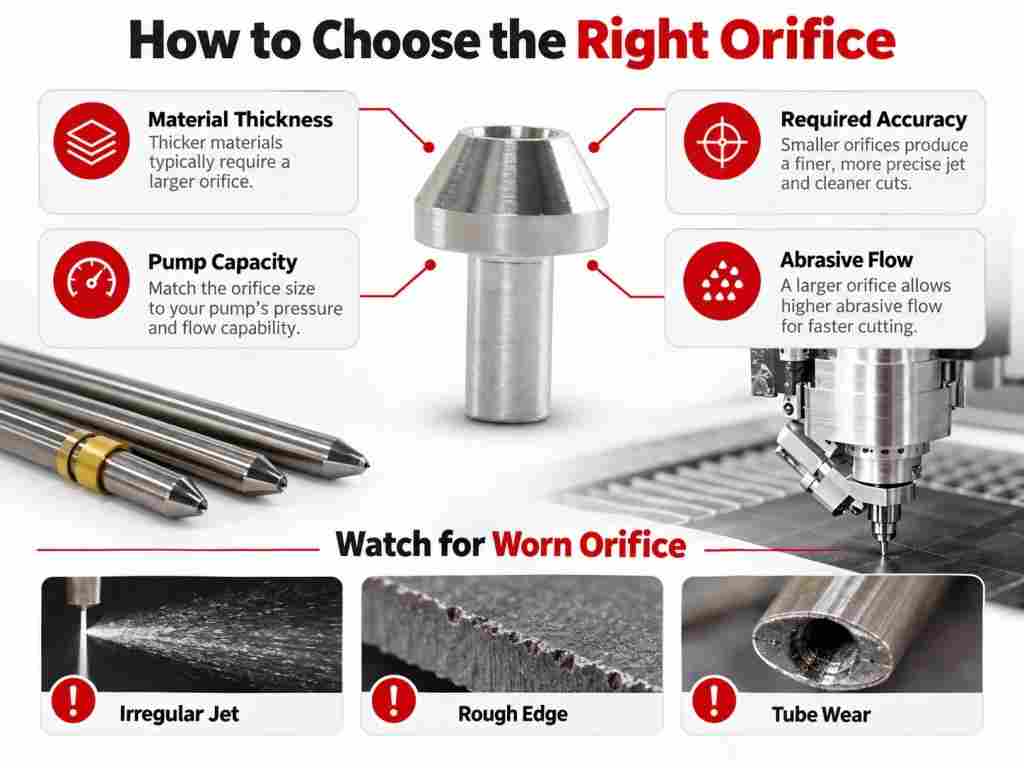
When selecting a nozzle, consider the following factors:
Material type
Material thickness
Desired kerf width (cut width)
Required cutting precision
Pump pressure
Pump power and flow capacity
Focusing tube inner diameter
Abrasive flow rate
Expected cutting speed
For cutting high-value or delicate gemstones, smaller nozzle combinations are generally recommended.
For thicker materials or applications requiring higher production speeds, larger nozzle combinations may be more appropriate.
There is no single "best" orifice size that suits every application.
How KUNDA Helps Customers?
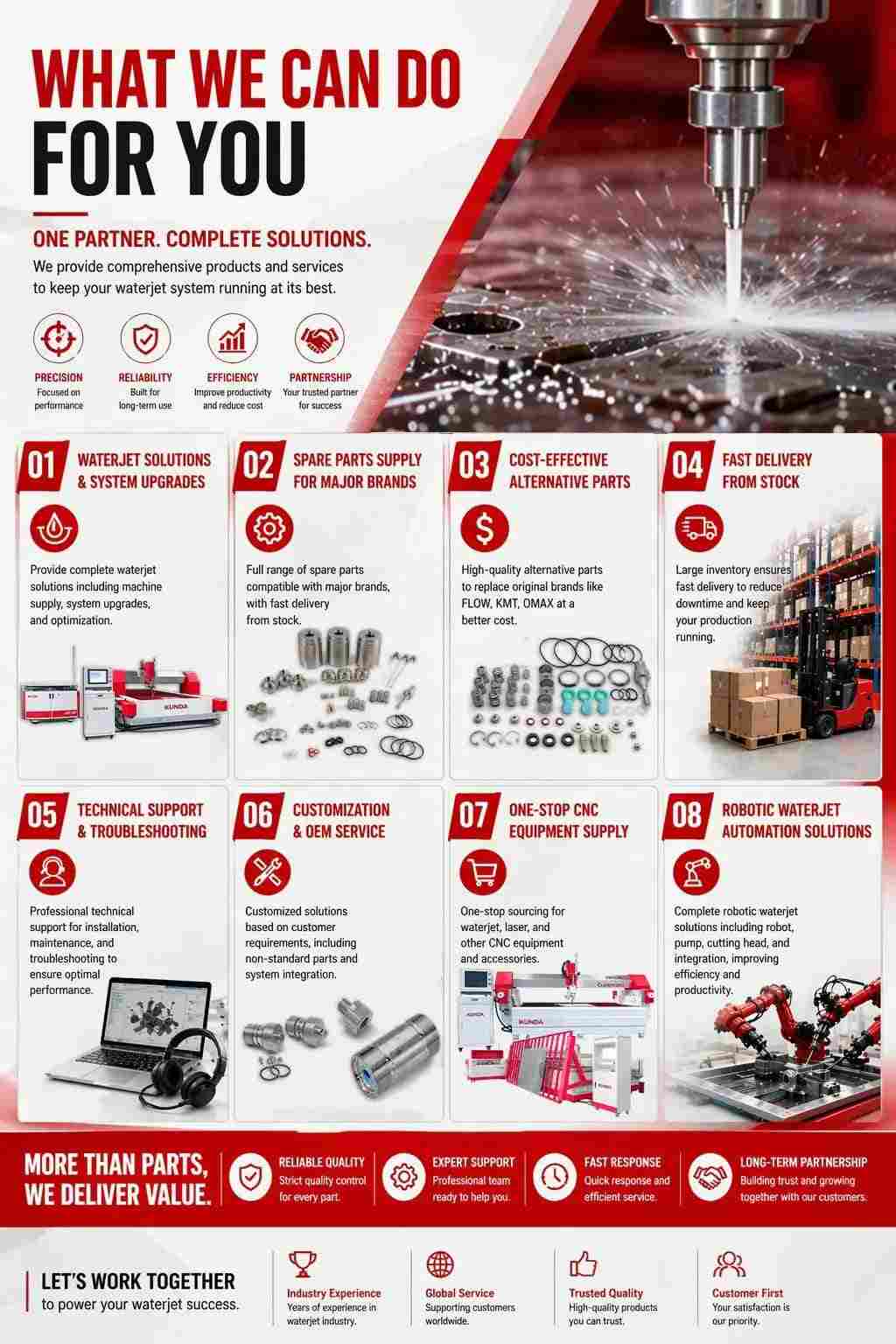
KUNDA offers the following products:
Ruby nozzles
Sapphire nozzles
Diamond nozzles
Focusing tubes
Mixing chambers
Cutting head components
Abrasive system components
Waterjet Pump components
Customers can provide us with details such as the cutting head model, nozzle orifice size, focusing tube specifications, pump pressure, and the type and thickness of the material being processed.
KUNDA can help evaluate whether your current nozzle configuration is suitable and recommend appropriate replacement parts.
In the field of gemstone cutting, smaller orifice sizes are ideal for achieving fine, precise cuts while minimizing material waste; conversely, larger orifice sizes provide greater cutting power for thicker or more challenging workpieces.
Most importantly, the nozzle orifice, focusing tube, abrasive flow rate, and pump performance parameters must be properly matched to create an effective, integrated cutting system.
Contact Us
Email: info@kundacnc.com
WhatsApp: +86 157 9367 0759
FAQ
1. Is a smaller orifice better for gemstone cutting?
Not always. A smaller orifice can help produce a finer cutting stream, but it also reduces available water flow and cutting power.
2. Does a larger orifice cut faster?
It can, provided the pump has enough power and flow capacity and the focusing tube and abrasive flow are correctly matched.
3. Does orifice size affect kerf width?
Yes. The complete orifice/focusing-tube combination influences jet diameter and therefore the final cutting kerf.
4. Can the wrong orifice damage the focusing tube?
An incorrect or damaged orifice can cause poor jet alignment or unsuitable operating conditions, which may accelerate focusing tube wear.
5. Should I choose the orifice and focusing tube together?
Yes. They should be selected as a matched combination rather than as two independent parts.

No previous


