
Waterjet Knowledge
How to Choose Waterjet Garnet Abrasive Mesh Size?
How to Choose Waterjet Garnet Abrasive Mesh Size?
Garnet abrasive is one of the most important consumables in abrasive waterjet cutting.
In addition to the quality of the abrasive itself, the mesh size (grain size) affects cutting speed, edge quality, Focusing Tube lifespan, abrasive consumption, and cutting stability.
Selecting the appropriate garnet mesh size helps improve the efficiency of the waterjet system and reduces unnecessary consumable costs.
What is garnet mesh size?
Mesh size is used to describe the approximate size of the abrasive particles.
Generally speaking:
Lower mesh number = larger particles; higher mesh number = smaller particles.
Common waterjet garnet specifications include: 50 mesh, 60 mesh, 80 mesh, 100 mesh, and 120 mesh.
Among these, 80 mesh is one of the most commonly used specifications for general abrasive waterjet cutting.
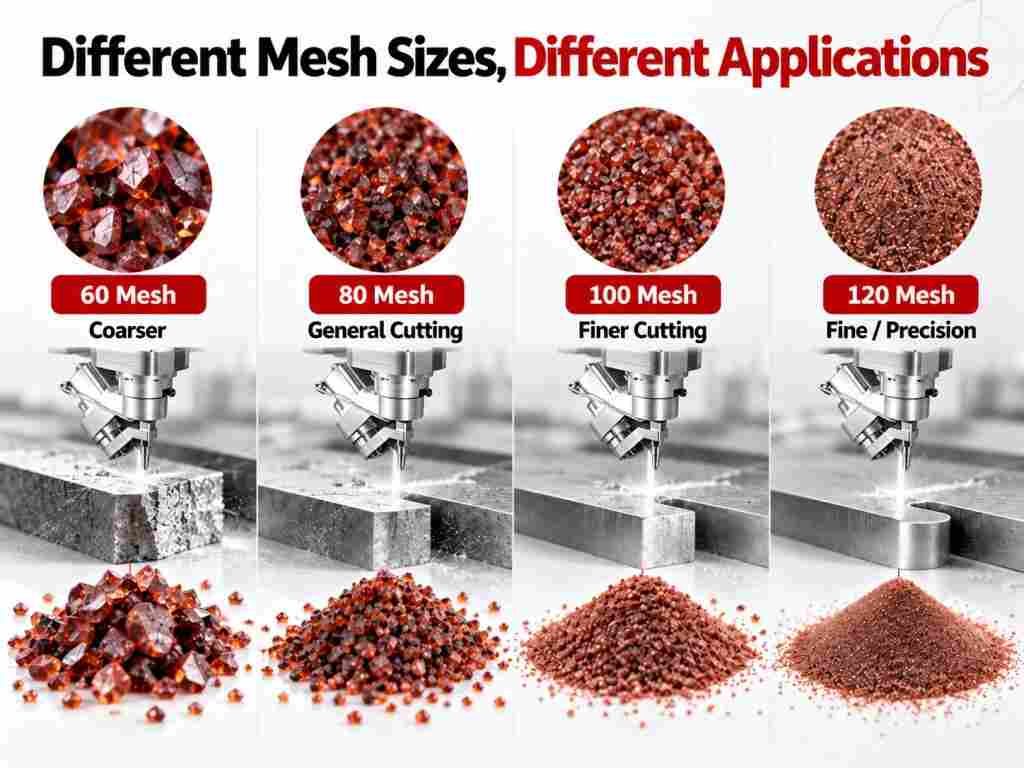
1. 80 Mesh — A Common Choice for General Cutting
For many waterjet cutting applications, 80-mesh garnet strikes an optimal balance between cutting speed, surface quality, and abrasive flow rate.
It is commonly used to cut materials such as steel, stainless steel, aluminum, stone, glass, ceramics, and composites.
For many standard waterjet systems, 80 mesh serves as a practical starting point.
However, the final choice must still be compatible with the specific cutting head, focusing tube, abrasive feeder, and the material being processed.
2. Coarser Garnet: 50–60 Mesh
A lower mesh number indicates larger abrasive particles.
Coarser garnet may provide greater cutting power in certain applications and is suitable for: thick materials, high-speed cutting operations, and applications where extreme edge precision is not required.
However, larger particles require a focusing tube with a sufficiently large internal diameter.
3. Finer Garnet: 100–120 Mesh
A higher mesh number indicates finer abrasive particles.
Fine-grained garnet may be more suitable when the following results are required: finer cutting details, a narrower kerf (cut width), superior surface finish, and higher cutting precision.
However, finer abrasive does not automatically equate to faster cutting speeds.
For thick materials or high-volume production, using abrasive that is too fine may reduce cutting efficiency, depending on machine settings.
The appropriate abrasive grain size should be selected based on the specific application, rather than simply choosing the finest grade available on the market.
Matching Garnet Mesh Size with the Focusing Tube
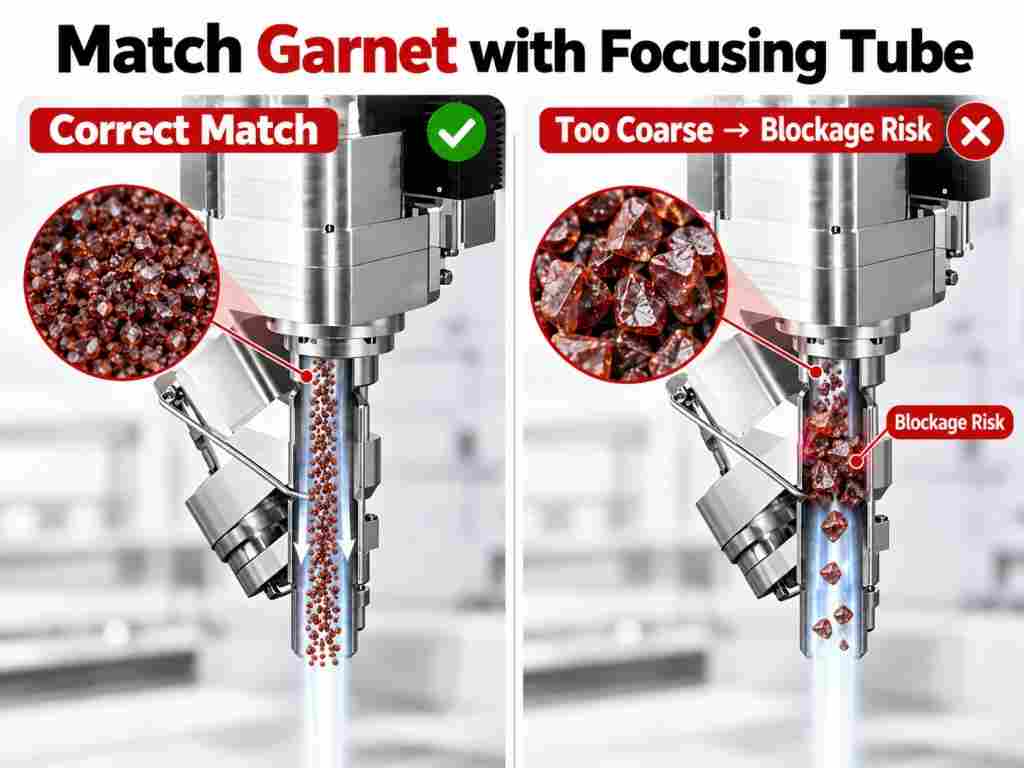
Garnet mesh size is closely linked to the dimensions of the focusing tube.
The abrasive must flow smoothly through the focusing tube.
Key factors include: focusing tube inner diameter, Nozzle Orifice diameter, abrasive flow rate, pump pressure, and cutting head design.
If abrasive particles are too large relative to the focusing tube's inner diameter, the risk of clogging increases.
If the abrasive is too fine for a specific application, cutting efficiency may decrease.
Therefore, the nozzle, focusing tube, and abrasive should be considered as an integrated system.
Matching Garnet Mesh Size with Material Thickness
Material thickness also influences the choice of abrasive.
A simple general guideline is as follows: for thin materials or precision machining:
Finer abrasives typically offer better control and superior surface quality.
General-purpose cutting: 80-mesh abrasive is widely used because it strikes a good balance between various performance metrics.
Thicker materials: In some systems, using a slightly coarser abrasive may be advantageous, provided the focusing tube can accommodate it.
There is no single "best" mesh size that suits every material.
Abrasive Quality Is Just as Important as Mesh Size
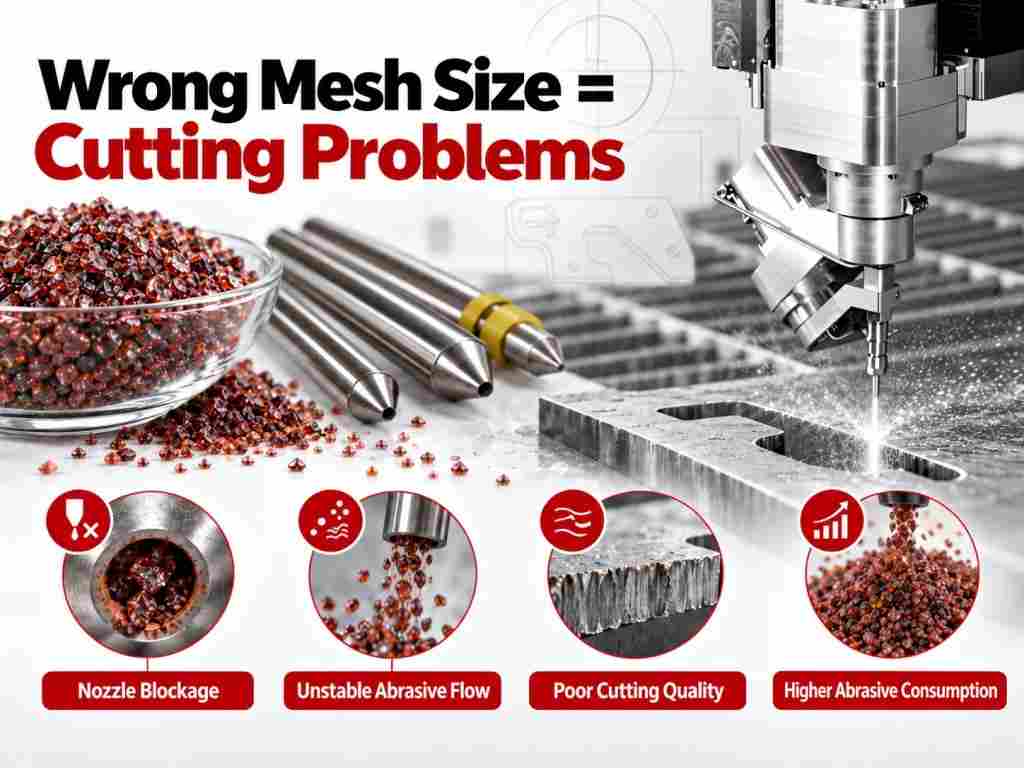
Even two garnet abrasives labeled as "80-mesh" can exhibit different performance characteristics.
Customers should also evaluate factors such as: particle size uniformity, dust content, moisture content, hardness, cleanliness, and impurity levels.
Low-quality abrasives may contain excessive dust or irregularly shaped particles.
This can lead to: abrasive clogging, accelerated focusing tube wear, unstable cutting, poor edge quality, and increased abrasive consumption.
Choosing clean, consistent garnet is generally more important than simply prioritizing a low price. Common Issues Caused by Improper Grit Size Selection
If the garnet grit size is unsuitable, customers may encounter the following problems: focusing tube clogs, unstable abrasive flow, slow cutting speeds, rough cut edges, widened kerf, excessive abrasive consumption, reduced focusing tube lifespan, and poor cutting consistency.
When these issues arise, please check the abrasive specifications and the condition of the cutting head. How to select the appropriate garnet abrasive grit size:
Before selecting an abrasive, please confirm the following information: material type, material thickness, required edge quality, focusing tube inner diameter, nozzle (jewel) orifice diameter, pump pressure, abrasive flow rate, and cutting speed requirements.
For most standard applications, 80 mesh is a common starting point, but the optimal grit size should always be matched to the specific cutting system.
How KUNDA Supports Waterjet Users?
KUNDA supplies Waterjet Cutting Machines, cutting head accessories, focusing tubes, nozzles, abrasive system components, and other replacement parts.
If customers experience issues such as frequent focusing tube clogs, excessive abrasive consumption, or poor cut quality, they can provide us with the following information: focusing tube specifications, nozzle orifice diameter, garnet grit size, pump pressure, material being cut, material thickness, and photos or videos of the cutting issues.
KUNDA can assist in evaluating whether the combination of abrasive and cutting head system is compatible.
Selecting waterjet garnet abrasive involves more than just choosing between 60, 80, or 120 mesh.
For many routine waterjet applications, 80-mesh garnet is a common and practical choice.
Most importantly, use clean, dry, and consistent-quality abrasive, and ensure it is compatible with the cutting head system.
Contact Us
Email: info@kundacnc.com
WhatsApp: +86 157 9367 0759
FAQ:How to Choose Waterjet Garnet Abrasive Mesh Size?
1. What is the most common garnet mesh size for waterjet cutting?
80 mesh is widely used for general abrasive waterjet cutting because it provides a good balance between cutting performance and surface quality.
2. Is 60 mesh better for thick materials?
It can be suitable for some heavy-duty applications, but the focusing tube and abrasive system must be able to handle the larger particles.
3. Does finer garnet give a better cutting surface?
Finer abrasive may improve surface finish in some applications, but it may not provide the best cutting speed for thick materials.
4. Can the wrong garnet mesh block the focusing tube?
Yes. If abrasive particles are too large or the garnet contains contamination or moisture, blockage risk increases.
5. Should garnet mesh match the focusing tube size?
Yes. Garnet mesh, focusing tube inner diameter, orifice size, abrasive flow, and pump pressure should be considered together.

No previous


