Waterjet Knowledge
How to Choose the Right Waterjet Focusing Tube?
How to Choose the Right Waterjet Focusing Tube?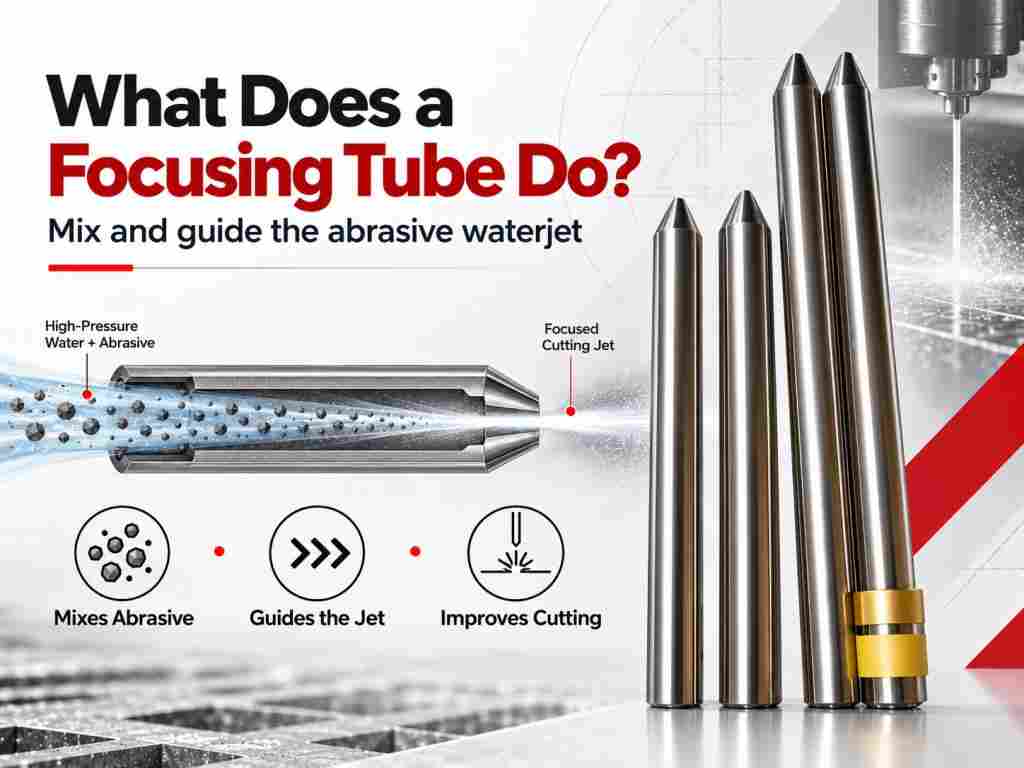
The Waterjet Focusing Tube is one of the most critical consumable parts in an abrasive Waterjet Cutting Head.
After high-pressure water mixes with the abrasive, the focusing tube guides and accelerates the abrasive waterjet, directing it toward the material to be cut.
If the focusing tube is incompatible with the cutting head or is severely worn, cutting quality can deteriorate rapidly.
Selecting the right focusing tube helps improve cutting precision, reduce abrasive waste, and maintain the efficient operation of the Waterjet Equipment.
Why Is the Focusing Tube Important?
The focusing tube directly affects the shape and stability of the abrasive waterjet stream.
A high-quality focusing tube helps achieve:
A stable cutting jet
Higher cutting precision
Smoother cut edges
Higher abrasive utilization efficiency
More consistent cutting performance
As abrasive flows continuously through the focusing tube at high speed, it is a standard consumable part and should be inspected regularly.
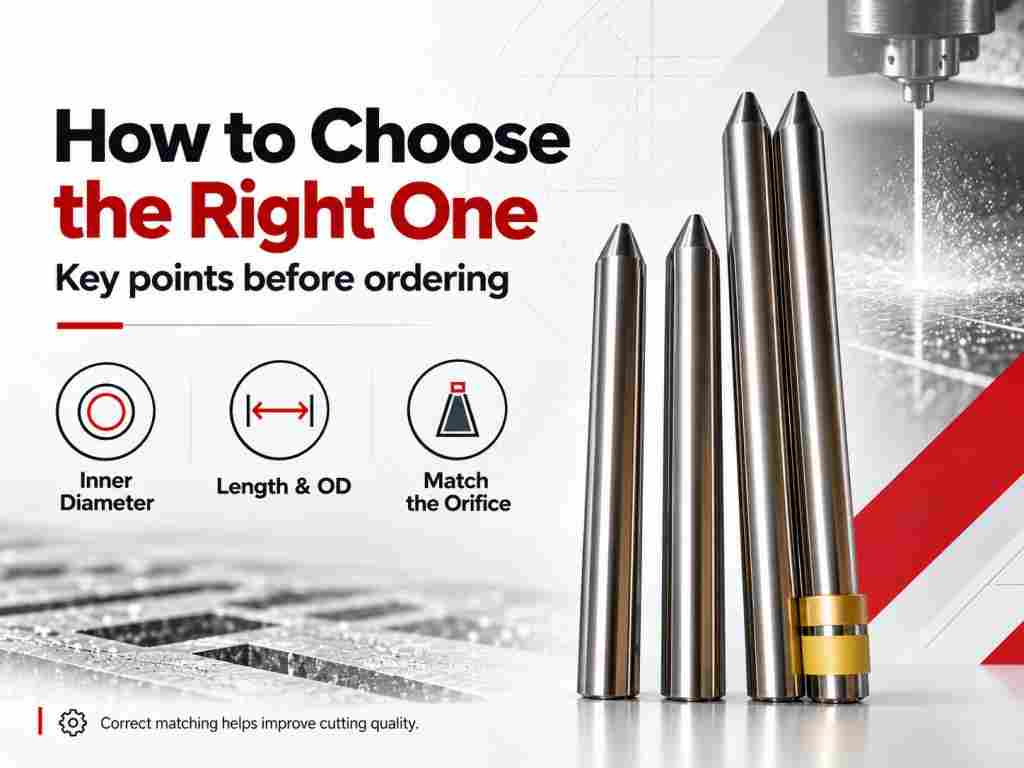
1. Choose the Correct Inner Diameter
The inner diameter is one of the most critical specifications.
Common inner diameters for focusing tubes include:
0.76 mm
0.89 mm
1.02 mm
1.14 mm
As well as other sizes depending on the cutting system.
The appropriate inner diameter should be matched to the Nozzle Orifice size, abrasive flow rate, pump pressure, and specific cutting requirements.
If the focusing tube's inner diameter is too large, the jet may diverge (losing its focusing effect), and abrasive consumption will increase.
If the inner diameter is too small, it may lead to unstable abrasive delivery or clogging.
The nozzle orifice and the focusing tube should always be selected as a matched set.
2. Check the Outer Diameter and Length
In addition to the inner diameter, customers should also verify the following information:
Outer diameter
Total length
Mounting configuration
Cutting head model
Two focusing tubes may look similar but are not necessarily compatible with the same cutting head model.
Before ordering, it is best to verify the part number or carefully measure the old focusing tube.
3. Choose the Right Material
Most high-quality focusing tubes are made of hard alloys (such as tungsten carbide) or similar carbide materials, offering exceptional wear resistance.
Material quality directly affects the following:
Wear resistance
Service life
Cutting stability
Inner bore precision
Inferior focusing tubes wear out rapidly, causing the inner bore to enlarge or become irregularly shaped.
This not only degrades cutting quality but also increases abrasive consumption.
4. Match the Focusing Tube with the Orifice
The focusing tube cannot be selected independently of the nozzle (orifice).
The nozzle generates the high-speed water stream, while the focusing tube mixes and directs the abrasive jet.
A mismatch between the two can lead to the following issues:
Unstable jet
Poor abrasive mixing
Accelerated wear of the focusing tube
Reduced cutting efficiency
To ensure stable cutting, the nozzle size and focusing tube size must be correctly matched.
5. Consider the Cutting Material and Application
Different cutting applications may require focusing tubes of various sizes.
For example:
Cutting thin materials may allow for a narrower cutting jet;
Cutting thick materials may require a larger volume of abrasive and a larger focusing tube;
Precision cutting may call for a more concentrated jet;
High-output cutting may prioritize durability and the stability of the abrasive flow;
The specific choice depends on the material type, thickness, cutting speed, and the required edge quality.
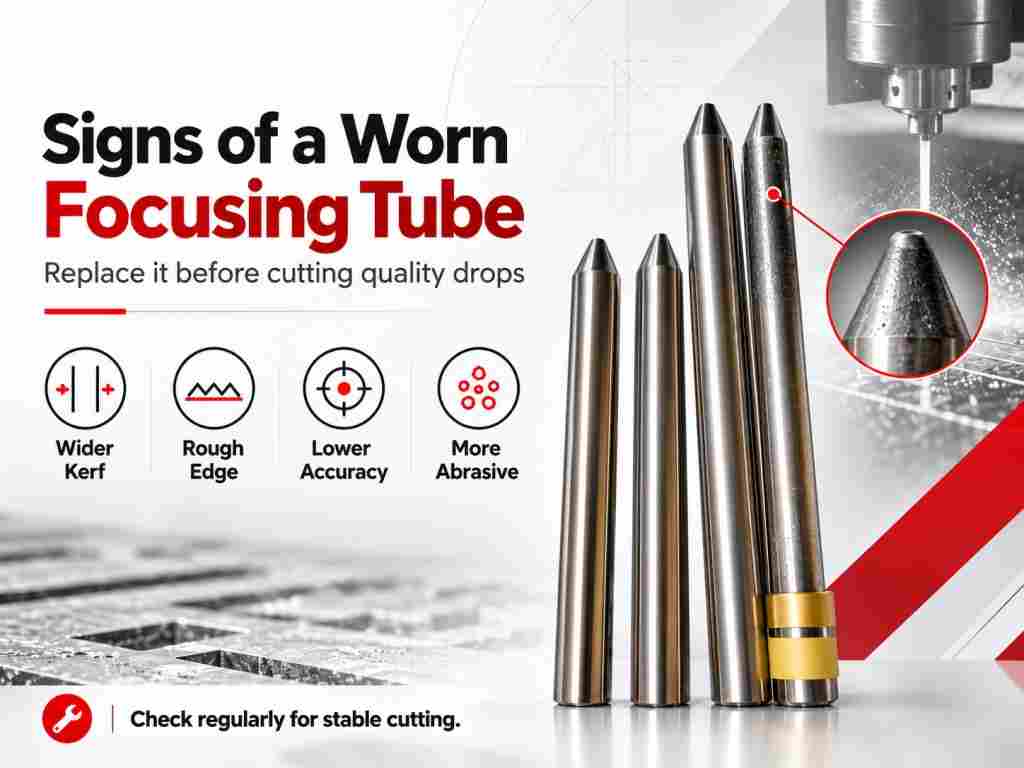
How to Know If the Focusing Tube Is Worn?
Focusing tube wear can lead to the following noticeable issues:
Rough cut edges
Reduced cutting precision
Slower cutting speeds
Increased abrasive consumption
Unstable cutting jet
Poor surface finish
If these issues occur, the customer should inspect the focusing tube, as well as the nozzle (jewel orifice) and the abrasive delivery system.
Why does a Focusing Tube Wear Too Quickly?
Common causes include:
Poor abrasive quality
Improper abrasive mesh size (grit size)
Mismatched nozzle and focusing tube combination
Misaligned waterjet
Damaged nozzle
Excessive abrasive flow rate
Inferior focusing tube material
Contaminants inside the cutting head
If the focusing tube wears out much faster than normal, simply replacing it may not resolve the root cause.
The cutting head should be inspected as an integrated system.
How KUNDA Helps Customers Choose the Right Focusing Tube
KUNDA supplies waterjet focusing tubes, jewel orifices, cutting head components, and other consumables to customers worldwide.
Customers can provide us with the following information:
Part number
Cutting head model
Focusing tube dimensions
Jewel orifice specifications
Photos of the old part
Equipment brand
Pump pressure
We offer focusing tubes for a wide range of mainstream waterjet systems, including:
FLOW
KMT
OMAX
AccuStream
WSI
BF
Resato
Tehni
And other compatible waterjet systems
Selecting the right waterjet focusing tube involves more than just considering the diameter.
Customers should also consider:
Inner diameter
Outer diameter
Length
Material quality
Jewel orifice compatibility
Cutting head compatibility
Cutting application
Choosing the appropriate focusing tube helps improve cutting quality, reduce abrasive consumption, and lower long-term maintenance costs.
If you are unsure which focusing tube you need, please send the part number, photos of the old part, cutting head model, or dimensional information to KUNDA, and we will help you determine the right choice.
FAQ:How to Choose the Right Waterjet Focusing Tube?
1. Are the focusing tube and the mixing tube the same component?
Yes. In many waterjet systems, the terms "focusing tube," "mixing tube," and "abrasive nozzle" refer to the same or very similar cutting head components.
2. How often should the focusing tube be replaced?
There is no fixed replacement interval. Its service life depends on factors such as abrasive quality, operating time, alignment, cutting parameters, and the quality of the tube itself.
3. Can focusing tubes with different inner diameters be used?
Yes, but the size must match the jewel orifice (nozzle diameter), abrasive flow rate, and the specific cutting application. Improper configuration may reduce cutting performance.
4. Why is my focusing tube wearing out so quickly?
Possible causes include: poor abrasive quality, a damaged jewel orifice, improper alignment, excessive abrasive flow, or inferior tube material.
5. Can KUNDA assist in selecting the right focusing tube?
Yes. Please provide the part number, dimensions, a photo of the old part, the cutting head model, or equipment details, and KUNDA will help you identify the appropriate replacement.