Waterjet Solutions
Is Waterjet Cutting Replacing Traditional Metalworking Methods?
Is Waterjet Cutting Replacing Traditional Metalworking Methods?
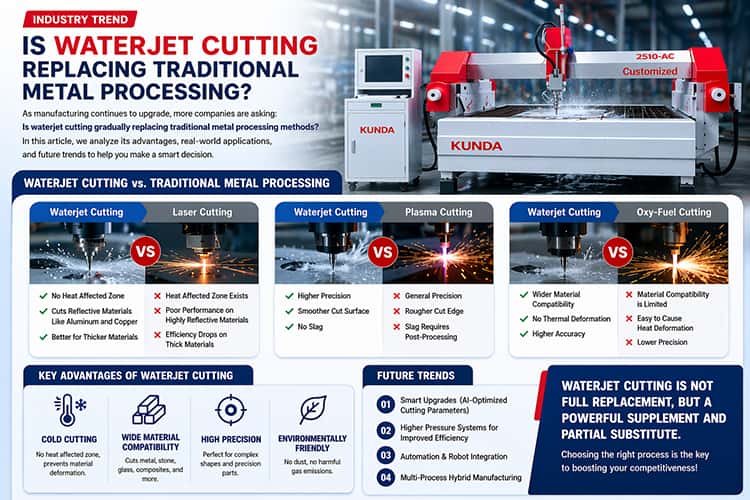
For decades, traditional metalworking methods—such as laser cutting, plasma cutting, and flame cutting—have dominated the market. However, in recent years, waterjet cutting technology has advanced rapidly; its scope of application has continuously broadened, and in certain specific scenarios, it has even begun to demonstrate a clear trend toward replacing these traditional methods.
So, can waterjet cutting truly replace *all* traditional processes? In the following sections, we will conduct an in-depth exploration of this topic, examining the inherent advantages of the technology, its practical application scenarios, and its future development trends.
What Exactly Is Waterjet Cutting Technology?
Waterjet cutting—also known simply as "waterjetting"—achieves material cutting by utilizing an ultra-high-pressure stream of water reaching pressures of up to 300 to 420 megapascals (MPa). When processing metals, an abrasive material—such as garnet sand—is typically added to the water stream to create an "abrasive waterjet" possessing powerful cutting capabilities.The most distinctive feature of this technology is its "cold cutting" process; that is, it generates no heat-affected zone (HAZ) and can be flexibly applied to the processing of a wide variety of materials.
A Comparison of Waterjet Cutting and Traditional Metalworking Methods
1. Waterjet Cutting vs. Laser CuttingAdvantages:
Its primary advantages include: the absence of a heat-affected zone during processing, which ensures the material's original structural integrity remains unaltered; the ability to effectively cut highly reflective materials such as aluminum and copper; and—simultaneously—a demonstrated superior capability in processing thicker materials.
Disadvantages:
However, its drawbacks are also quite evident: the cutting speed is typically relatively slower, and the initial capital investment required for the equipment is comparatively higher.
2. Waterjet Cutting vs. Plasma Cutting
Advantages:
Its advantages are manifested in higher cutting precision, smoother cut edges, and a slag-free finish.
Disadvantages:
Comparatively speaking, both its energy consumption and the cost associated with abrasive materials tend to be higher.
3. Waterjet Cutting vs. Flame Cutting
Advantages:
The advantages of waterjet cutting lie in its ability to process a wider variety of materials, its prevention of thermal deformation, and its superior processing precision. Disadvantages:
However, when processing exceptionally thick steel plates, its overall efficiency may not match that of flame cutting.
Key Advantages of Waterjet Cutting
No Heat-Affected Zone (i.e., "Cold Cutting")This technology does not generate high temperatures during the processing phase; consequently, it effectively prevents issues such as material hardening, deformation, or scorching.
Broad Material Versatility
It is capable of cutting not only metals but also a wide variety of other materials, including stone, glass, and composite materials.
High Precision and Complex Processing Capabilities
This technology is particularly well-suited for fabricating intricate curved shapes and manufacturing precision components with exacting specifications.
Significant Environmental Benefits
The processing operation generates neither smoke nor dust, and involves no emission of harmful gases; thus, it is better positioned to meet current environmental standards and regulatory requirements.
Is Waterjet Cutting Truly "Replacing" Traditional Processes?
Based on current industry development trends, a more accurate characterization would be this:Rather than a complete replacement, waterjet cutting serves to "complement and partially substitute" traditional methods.
In the following specific application scenarios, waterjet cutting is gradually demonstrating a trend toward replacing traditional methods:
Metal processing tasks requiring extremely high precision
Processing of materials that are particularly sensitive to thermal effects
Cutting tasks involving complex geometries
The manufacturing of high-value-added products
However, in certain domains, traditional processes continue to retain their unique advantages:
For high-volume processing tasks where precision requirements are not particularly stringent
When cutting exceptionally thick steel plates, flame cutting still holds significant advantages
In application scenarios where cutting speed is of paramount importance, laser cutting delivers superior performance
As we can see, waterjet cutting is not intended to completely displace traditional metalworking methods; however, it is indeed evolving rapidly to become a pivotal processing technology within the realm of high-end manufacturing. It has emerged as an indispensable and ideal choice—particularly in scenarios demanding high precision, involving the processing of complex materials, or subject to extremely rigorous environmental standards.
Therefore, for enterprises, a deep understanding and flexible application of the unique advantages inherent in various processing technologies will be the key to enhancing their core competitiveness within the marketplace.